
Research · Leadership
AI Can Accelerate Research. It Cannot Own the Judgment.
AI is changing how quickly we can conduct research, analyze evidence, and communicate insights. But the responsibility for understanding people and making informed decisions still belongs to us.

In this article
Artificial intelligence is creating extraordinary opportunities for UX research. Activities that once required considerable manual effort can increasingly be supported by tools that organize research data, identify potential patterns, summarize conversations, and help researchers explore large volumes of evidence.
For organizations struggling to meet growing research demand, these capabilities are understandably appealing. Research teams are frequently asked to support more products, more decisions, and more stakeholders without corresponding increases in resources. The possibility of reducing the time spent on repetitive analytical and administrative activities creates an opportunity to expand what those teams can accomplish.
I believe we should embrace that opportunity.
But as AI becomes more deeply integrated into research practices, I think we need to distinguish between accelerating the research process and transferring responsibility for the conclusions it produces.
Those are fundamentally different things.
AI can organize information, identify potential relationships, suggest interpretations, and generate remarkably polished summaries. What it cannot do is assume professional responsibility for determining whether the research was appropriate, whether the evidence is sufficient, what the findings mean within an organization's particular circumstances, or which conclusions should influence consequential decisions.
Those responsibilities remain with researchers and the organizations that rely on their work.
The opportunity ahead isn't simply to conduct more research in less time. It's to use AI to expand our capacity for understanding while strengthening the human judgment that makes research valuable.
Speed changes the process. It doesn't guarantee understanding.
Research has always involved a considerable amount of work that supports analysis without necessarily constituting analysis itself.
Researchers spend time preparing recordings, reviewing transcripts, organizing observations, categorizing feedback, comparing responses, retrieving previous findings, and developing materials that communicate what they've learned.
These activities are important, but they can also consume time that experienced researchers might otherwise spend investigating complex problems, examining contradictory evidence, or working with stakeholders to understand the implications of their findings.
AI offers an opportunity to change that allocation of effort.
Consider the amount of information generated by even a relatively modest research initiative. Several interviews can produce hours of recordings, extensive transcripts, hundreds of individual observations, and multiple potential interpretations. When research extends across numerous studies, products, or business units, the volume becomes substantially more difficult to manage.
AI-assisted tools can help researchers navigate this information, locate relevant material, develop preliminary summaries, and identify relationships worth investigating. Used appropriately, they can reduce some of the effort required to move from raw research material toward a structured understanding of what participants experienced.
That's valuable progress.
But accelerating the organization of evidence is not the same as accelerating understanding. A tool can produce a coherent summary before a researcher has adequately examined the underlying material. It can identify recurring language without recognizing why seemingly similar statements reflect different experiences. It can generate a persuasive interpretation without establishing whether that interpretation is adequately supported.
In other words, the ability to produce an answer more quickly doesn't establish that we understand the problem any better.
The distinction matters because research isn't simply an information-processing activity. It is an investigative discipline that requires us to evaluate evidence, recognize uncertainty, understand context, and remain willing to challenge our initial interpretations.
As AI reduces the effort required to produce research outputs, we need to be increasingly deliberate about preserving those responsibilities.
The easier it becomes to generate an interpretation, the more important it becomes to verify that interpretation against the evidence.
Pattern recognition is not the same as understanding people
One of the most promising applications of AI in research is its ability to help identify patterns across large collections of information.
Patterns matter. They can reveal recurring problems, highlight relationships between observations, and direct researchers toward questions they might otherwise overlook.
But patterns require interpretation.
Imagine that an AI-assisted analysis identifies a recurring complaint about a particular digital experience. Several participants describe the same task as confusing, and the system identifies that confusion as a prominent theme.
That may be an accurate description of the available evidence. It is not necessarily an adequate explanation of the underlying problem.
The difficulty might originate in the interface, but it could also reflect unfamiliar terminology, inconsistent information across channels, a complicated organizational process, or expectations established long before the customer encountered the product.
Even participants who use similar language may be experiencing fundamentally different problems.
Understanding those distinctions requires examining the circumstances surrounding individual observations, connecting qualitative findings with other available evidence, and considering what the organization already knows about its customers and products.
It also requires recognizing that frequency and importance are not interchangeable.
A problem mentioned repeatedly in a small study may deserve attention, but repetition alone does not establish how widespread that problem is. Conversely, a difficulty encountered by only one participant may expose a significant accessibility issue, an important failure affecting a particular customer population, or a previously unrecognized risk.
An automated summary that emphasizes the most frequently occurring observations could unintentionally direct attention away from evidence that deserves deeper investigation.
That doesn't make AI-assisted analysis inherently unreliable. It means that the output needs to be understood within the methodological limitations of the research.
Experienced researchers bring that perspective. They understand why the study was conducted, how participants were selected, which methods were used, what additional evidence exists, and where the available information is insufficient to support a particular conclusion.
AI can help researchers identify where to look. Researchers must remain responsible for determining what the evidence actually supports.
The danger of conclusions that look more certain than they are
I've become particularly interested in a challenge that AI introduces into the communication of research: the appearance of certainty.
Generative AI can produce exceptionally clear and convincing language. It can transform an extensive collection of research material into a concise executive summary, organize findings into themes, and suggest implications using the kind of polished presentation that stakeholders often expect.
That capability can be tremendously useful.
But the quality of the writing should never be confused with the quality of the underlying analysis.
A well-written summary can conceal weak evidence, unresolved contradictions, questionable assumptions, or important limitations. An AI-generated interpretation may appear authoritative even when it reflects an incomplete understanding of the research.
This becomes especially consequential when research findings move beyond the original research team.
A product manager may receive a summary without reviewing the underlying observations. A design leader may incorporate its conclusions into planning. An executive may encounter the same information in a presentation supporting an investment decision.
At every stage, the distance between the original evidence and the person making a decision increases.
If the initial interpretation is incomplete or inaccurate, the problem can become more difficult to recognize as the information moves through the organization.
This isn't an entirely new research challenge. Organizations have always faced the risk of oversimplifying findings, overlooking contradictory evidence, or communicating conclusions with more confidence than the methodology supports.
AI can accelerate that process, making it possible to generate and distribute polished interpretations before anyone has adequately challenged them.
The appropriate response isn't to avoid AI-generated summaries. It's to establish a clear distinction between an analytical starting point and a research conclusion that has been professionally reviewed and accepted.
The easier it becomes to generate an interpretation, the more important it becomes to verify that interpretation against the evidence.
ARTICLE 05 / INLINE ILLUSTRATION
AI accelerates. People remain accountable.
Automation can support the workflow without becoming the authority behind the findings.
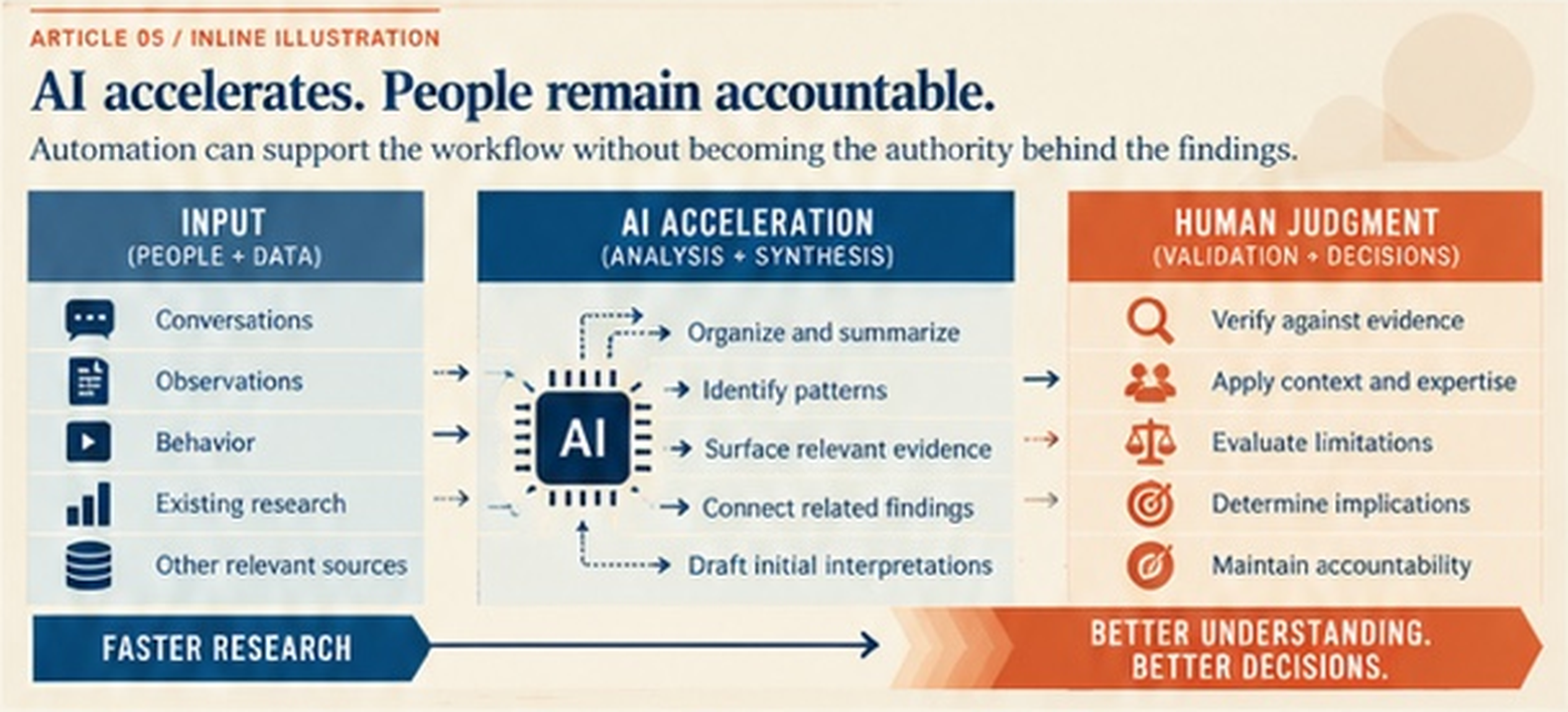
Read diagram text
Automation can support the workflow without becoming the authority behind the findings.
Input
(People + Data)
- Conversations
- Observations
- Behavior
- Existing research
- Other relevant sources
AI Acceleration
(Analysis + Synthesis)
- Organize and summarize
- Identify patterns
- Surface relevant evidence
- Connect related findings
- Draft initial interpretations
Human Judgment
(Validation + Decisions)
- Verify against evidence
- Apply context and expertise
- Evaluate limitations
- Determine implications
- Maintain accountability
BETTER DECISIONS.
Human review must be more than a procedural step
One approach I've discussed in my work with enterprise organizations involves combining research inputs with other experience measures, using AI to help develop summaries, and having a person review, correct, and approve the interpretation before it is shared more broadly.
An important part of that approach is preserving the reviewed summary rather than generating a new interpretation every time another stakeholder wants to understand the findings.
There are two important principles behind this.
First, AI-generated analysis should be treated as material requiring evaluation rather than as an automatically accepted research conclusion. Someone needs to examine the underlying evidence, determine whether the summary accurately represents it, correct unsupported interpretations, and ensure that important context hasn't been lost.
Second, once that work has been completed, the organization benefits from maintaining an authoritative, reviewed interpretation that people can reference consistently.
Without that consistency, different stakeholders could receive different explanations of the same research simply because they generated their summaries independently. Variations in prompts, available information, and generated responses could introduce unnecessary uncertainty into decisions that should be informed by the same underlying evidence.
The human review process provides an opportunity to establish a shared understanding of what the research supports.
However, I believe we need to be careful about what we mean by human review.
Simply reading an AI-generated summary and deciding that it sounds reasonable is not an adequate quality control process.
Meaningful review requires researchers to return to the evidence. They need to examine whether the identified themes are supported, whether important observations have been omitted, whether contradictory findings are represented appropriately, and whether the strength of the conclusions matches the strength of the research.
In some situations, that may require reviewing source recordings or transcripts, examining individual observations, or reconsidering how findings have been categorized.
It may also require rejecting an attractive interpretation because the available evidence doesn't support it.
Human oversight is valuable because people can apply methodological knowledge and contextual judgment, not simply because a person has approved the finished document.
If AI is going to accelerate research responsibly, that distinction needs to be reflected in the way our research processes are designed.
Build research workflows that preserve accountability
I believe research leaders should approach AI adoption as an opportunity to redesign research workflows rather than simply introduce new tools into existing processes.
The central question shouldn't be how many activities we can automate. It should be which activities benefit from automation, where human expertise adds the greatest value, and how we preserve the integrity of the research from beginning to end.
That requires understanding where different forms of judgment enter the process.
At the beginning of a research initiative, someone must determine which problem deserves investigation, what uncertainty the organization needs to resolve, and which evidence would support a meaningful decision. AI may help identify possible research questions or reveal gaps in existing knowledge, but responsibility for framing the study remains with the research team.
During analysis, AI may help organize observations, develop preliminary categories, and identify potential themes. Researchers still need to determine whether those patterns are meaningful, investigate alternative explanations, and evaluate the methodological limitations of their conclusions.
During synthesis, AI can help researchers develop narratives and communicate complex information. But researchers must establish which findings are sufficiently supported, which conclusions remain uncertain, and which implications stakeholders should consider.
Finally, when research informs product or business decisions, accountability belongs to the people responsible for those decisions.
AI can contribute throughout this process without becoming the authority at any point.
The important consideration is that human responsibility must be deliberately incorporated into the workflow. It cannot depend entirely on researchers noticing when automated outputs require additional scrutiny.
Research organizations should establish expectations for reviewing AI-assisted analysis, preserving connections to original evidence, documenting consequential interpretations, and communicating uncertainty.
They also need clear standards for protecting participant information and determining which research materials can appropriately be processed using particular AI systems.
Those standards should reflect the nature of the research and the consequences of getting something wrong. Research involving sensitive personal information, vulnerable populations, or consequential decisions may require substantially greater scrutiny than a routine evaluation of a low-risk interaction.
The objective isn't to make every use of AI cumbersome. It's to establish appropriate safeguards while allowing teams to benefit from the technology.
Don't automate away the discovery process
There is another concern I think deserves attention, particularly as research teams become more comfortable with AI-generated summaries and automated analysis.
The process of examining research evidence has value beyond producing the final findings.
When researchers spend time reviewing customer conversations, observing behavior, comparing experiences, and investigating inconsistencies, they develop a deeper understanding of the people and problems they're studying.
They encounter unexpected details. They recognize changes in tone. They notice when participants struggle to explain their experiences or when their observed behavior differs from what they report.
They also develop new questions that may not have been apparent when the study began.
Not every observation becomes part of the final research report, but many contribute to the researcher's broader understanding of the problem.
If we reduce research to the rapid consumption of automated summaries, we risk losing some of those opportunities for discovery.
I'm not suggesting that researchers should manually review every recording or transcript simply because that has historically been part of the process. As tools improve, there will be legitimate opportunities to reduce repetitive work and develop more efficient approaches to analysis.
But we should be thoughtful about which activities we remove.
The objective is to eliminate unnecessary effort without eliminating the experiences that develop professional understanding and reveal unexpected insights.
Sometimes the most important finding is the one that doesn't fit neatly into the patterns we expected to discover.
Research processes need to preserve opportunities to recognize those exceptions rather than optimizing exclusively for speed and consistency.
AI should expand the researcher's capacity for judgment
One of the more interesting possibilities created by AI is that it may allow experienced researchers to spend more time on the activities that benefit most from their expertise.
Research teams frequently face a difficult balance between conducting studies, managing research operations, analyzing evidence, supporting stakeholders, and contributing to strategic planning.
When the demand for research exceeds available capacity, the immediate response is often to prioritize studies, reduce scope, or look for ways to increase productivity.
AI introduces another possibility.
If researchers can reduce the effort required for appropriate administrative and analytical tasks, they may have greater capacity to investigate complex problems, explore emerging customer needs, evaluate conflicting evidence, and work more closely with product and business leaders.
That could fundamentally change the value research teams are able to contribute.
But realizing that opportunity requires leadership.
Without deliberate direction, increased efficiency may simply produce expectations for more studies, more findings, and faster delivery. The organization becomes more productive without necessarily becoming more effective.
Research leaders have an opportunity to establish a different objective: using technology to increase the amount of meaningful research the organization can support while strengthening the depth, quality, and influence of that work.
This also has implications for research democratization.
AI-assisted tools may make certain research activities more accessible to designers and product teams. That can be beneficial when the organization has established appropriate training, methodological guidance, and access to experienced researchers.
But easier access to analysis doesn't automatically produce the judgment necessary to interpret it.
The same principle that applies to democratizing research applies to AI adoption. Technology should expand organizational capability, not create the appearance of capability where the necessary expertise hasn't been developed.
The research leader's role becomes more important
As AI takes on a greater role in research execution and analysis, the responsibilities of research leaders will continue to evolve.
Traditional research leadership has often concentrated on methodology, team development, research operations, stakeholder relationships, and the delivery of credible insights.
Those responsibilities remain essential, but AI introduces new questions about how research organizations should operate.
Leaders need to determine where automation is appropriate, how to evaluate emerging tools, which processes require human review, how research quality will be maintained, and what capabilities their teams need to develop.
They also need to consider the organizational consequences of changing how research is conducted.
If analysis becomes easier, will research teams investigate more strategically important questions, or will the organization simply generate more reports? If designers gain access to increasingly capable AI-assisted research tools, will their ability to understand customers improve, or will they become more comfortable accepting conclusions they aren't equipped to evaluate?
And if research findings can be summarized almost instantly, how will the organization ensure that speed doesn't replace thoughtful interpretation?
These are leadership questions as much as technology questions.
They require research leaders to understand emerging capabilities while remaining grounded in research methodology, organizational development, and the practical realities of product decision-making.
I believe this creates an opportunity for research leaders to become more influential.
As technology changes the economics of producing research, the value of professional leadership increasingly includes determining how evidence should be generated, evaluated, communicated, and used throughout the organization.
The research leader's responsibility isn't simply to help the team adopt AI. It's to design a research organization in which AI contributes to better understanding and better decisions.
Measure the value of AI through better research outcomes
If we want AI to strengthen research, we also need to be thoughtful about how we evaluate its impact.
Time savings are an obvious starting point. Reducing the effort required to organize observations, prepare summaries, or retrieve existing findings can create meaningful operational benefits.
But efficiency alone is an incomplete measure of success.
An organization could significantly reduce the time required to produce research reports without improving the quality of its insights or increasing their influence on product decisions.
It could also introduce AI-assisted analysis that initially appears efficient but requires substantial additional effort to correct errors or verify unsupported interpretations.
A meaningful evaluation should consider the entire research workflow.
Are researchers spending less time on repetitive activities and more time investigating consequential questions? Is AI helping teams identify useful evidence that might otherwise be overlooked? Are findings sufficiently traceable to their sources? Do researchers have the time and expertise necessary to validate automated analysis? Are stakeholders receiving information that is accurate, understandable, and appropriately qualified?
Research leaders should also consider whether AI is improving the organization's ability to learn from previous work. Making established research findings easier to discover, connect, and appropriately reuse may create value that extends well beyond the efficiency of an individual study.
Ultimately, the most meaningful question is whether AI is helping the organization develop a better understanding of its customers and make more informed decisions.
That is a more demanding standard than simply producing research outputs faster, but it's also a more valuable one.
The future of research is a partnership between technology and human expertise
I don't believe the future of UX research should be framed as a competition between researchers and artificial intelligence.
AI will continue to change which activities require manual effort and how research organizations approach the generation and analysis of evidence. Some existing processes will become less necessary, while new methods, responsibilities, and opportunities will emerge.
Research organizations should be willing to evolve alongside those changes.
But technological capability doesn't eliminate the need for professional judgment. In many respects, it makes that judgment more consequential because research findings can be generated, communicated, and incorporated into organizational decisions much more quickly.
The responsibility for protecting research integrity, recognizing uncertainty, challenging assumptions, and representing human experiences accurately remains essential.
As leaders, our responsibility is to build organizations that combine technological capability with methodological expertise, professional development, appropriate safeguards, and a genuine commitment to understanding people.
That means embracing AI where it contributes meaningful value while remaining willing to question its outputs, recognize its limitations, and preserve accountability for the decisions informed by research.
I believe the greatest opportunity isn't to use AI to remove people from the research process. It's to give researchers greater capacity to focus on the human understanding, professional judgment, and organizational influence that make their work valuable.
AI can accelerate the research process. But researchers must remain accountable for the meaning we draw from the evidence and the decisions we help organizations make.