
Leadership · Design
The UX Leader’s Job Is Changing: From Managing Craft to Building Systems
The measure of a UX leader isn't simply the quality of the work their team produces. It's the organizational capability they build to consistently deliver better experiences.

In this article
Throughout my career, I've watched the responsibilities of UX leaders evolve considerably. What began as a discipline primarily concerned with creating better digital experiences has expanded into an increasingly important part of product strategy, customer experience, organizational development, and business transformation.
Yet many organizations continue to approach UX leadership as an extension of individual design or research expertise. They promote talented practitioners into leadership positions, give them larger teams and broader responsibilities, and expect them to maintain the same degree of involvement in the work that originally made them successful.
That approach makes sense up to a point. Strong UX leaders need a deep understanding of their disciplines. They should recognize excellent design, understand research methodology, appreciate the complexities of product development, and maintain the judgment necessary to guide their teams.
But the responsibilities change as the scope of leadership increases.
At a certain point, the greatest contribution a UX leader can make is no longer improving an individual experience or directing an individual research initiative. It is creating the organizational conditions that allow talented people to consistently deliver excellent work.
That requires a different kind of leadership. It means moving beyond managing the quality of individual deliverables and toward designing the people, processes, relationships, decision-making practices, and measurement systems that determine how an organization creates experiences.
In many respects, the organization itself becomes the leader's most important design challenge.
The transition from practitioner to organizational leader
My career began in creative design and digital product development. I spent years developing experiences, directing creative teams, working through technical constraints, and learning how design decisions influenced both customers and business performance.
Those experiences shaped how I approach leadership today. They gave me an appreciation for the craft and an understanding of the practical challenges that designers, researchers, developers, and product teams encounter when turning ideas into working products.
But as my responsibilities expanded into building businesses, leading multidisciplinary teams, establishing research practices, and guiding enterprise transformation, I began to recognize that individual expertise could only take an organization so far.
A talented designer can improve an interface. An experienced researcher can uncover an important customer problem. A strong product team can deliver an excellent experience. But sustaining that level of performance across multiple teams, products, and business units requires something more.
It requires an organization designed to support good work.
That means ensuring teams have the necessary expertise, understand what they're trying to accomplish, can access credible customer evidence, and have clear ways to make decisions. It also requires creating an environment in which people can develop their capabilities, challenge assumptions, collaborate effectively, and understand whether their work is producing the intended results.
These responsibilities become increasingly important as leaders move into Director, Head of, and executive positions.
The challenge is no longer simply managing the work. It is developing an organization capable of doing the work well.
In many respects, the organization itself becomes the leader’s most important design challenge.
Great work cannot depend on a single leader
One of the most important lessons I've learned about leadership is that an organization's effectiveness cannot depend entirely on the expertise or personal involvement of the person leading it.
A leader who must personally approve every design decision, interpret every research finding, resolve every disagreement, or establish direction for every initiative eventually becomes a constraint on the organization.
This frequently happens for understandable reasons. Leaders are often promoted because they are excellent practitioners. They're accustomed to solving difficult problems, exercising sound judgment, and being accountable for the quality of their work. When they become responsible for larger teams, their natural instinct is to continue contributing in those familiar ways.
Initially, that involvement may be extremely valuable. But as the organization grows, the same approach becomes increasingly difficult to sustain.
It also limits the development of the people around them.
If every consequential decision requires the leader's personal involvement, team members have fewer opportunities to exercise judgment, assume responsibility, and develop confidence in their own abilities. The organization may produce excellent work, but its capability remains concentrated in a small number of individuals.
I believe the responsibility of a senior UX leader is to change that relationship.
Instead of personally providing every answer, the leader should establish the direction, expectations, capabilities, and decision-making practices that allow other people to arrive at good answers.
That doesn't mean abandoning the work or delegating responsibility without providing support. It means creating an environment in which expertise can develop and decisions can be made effectively throughout the organization.
Strong leadership should increase an organization's capability, not its dependency on the leader.
The operating model is a design problem
I experienced this challenge directly while building research capability at USAA.
We began with a small research organization consisting of three people: myself, a researcher, and a research operations coordinator. Within six months, we doubled the team and eventually grew to twelve people, including researchers, research operations professionals, and service designers.
Increasing the size of the team was necessary, but simply adding researchers would not have addressed the broader organizational challenge. We were supporting a complex enterprise with multiple business lines, competing priorities, and an extensive design ecosystem.
We needed to develop an operating model capable of supporting different types of research needs while extending human-centered thinking throughout the organization.
We ultimately established three complementary capabilities: centralized strategic research, business-aligned research, and research enablement.
Centralized researchers focused on larger initiatives requiring dedicated expertise. Business-aligned researchers worked more closely with the organizations they supported, developing relationships and connecting research to product and business priorities. The enablement function focused on developing the ability of designers, product teams, and executives to understand and use human-centered insights.
Together, these capabilities supported more than 250 designers across over twenty design teams.
The important leadership challenge wasn't simply determining how to distribute the research backlog among twelve people. It was designing an organization that could deliver specialized expertise where necessary while developing research capability and human-centered thinking throughout the broader enterprise.
That required considering how different teams would interact, where expertise would reside, how research could support different types of decisions, and how the organization could become less dependent on a centralized team for every learning opportunity.
It also required looking beyond the research organization itself.
When I joined, human-centered insights were not an established part of the Product Development Lifecycle. By the time I left, insights and design thinking had become critical activities throughout that lifecycle.
The operating model was an important part of developing that broader capability, alongside enablement, executive mentorship, measurement, and maturity models.
For me, the experience reinforced an important principle: an organizational structure should not simply describe where people report. It should enable the capabilities, relationships, and decisions necessary to achieve the organization's objectives.
Designing that structure is one of the most consequential responsibilities of senior leadership.
ARTICLE 04 / INLINE ILLUSTRATION
From managing craft to building systems
Craft remains essential. Senior leaders also design the conditions that make great work repeatable.
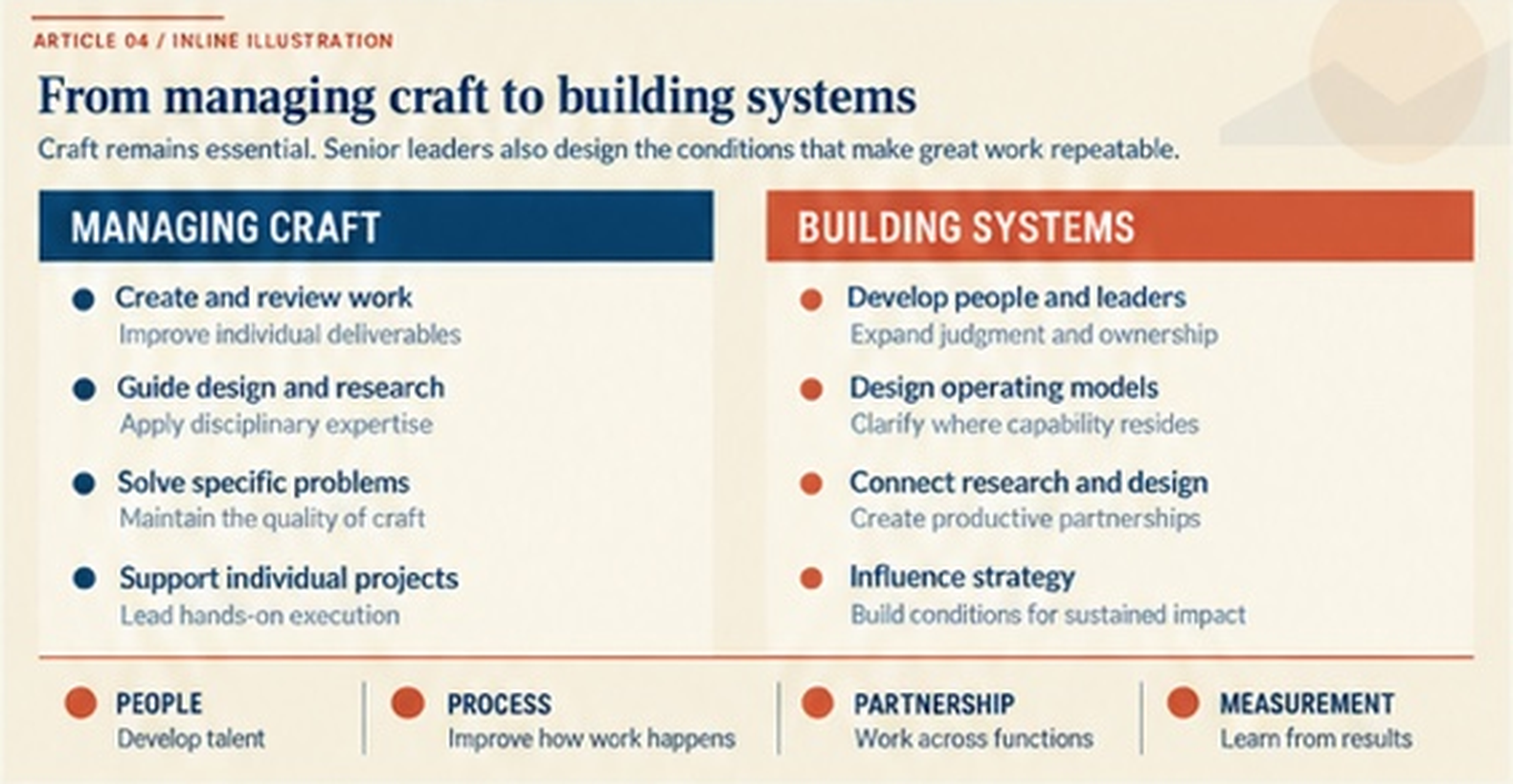
Read diagram text
Craft remains essential. Senior leaders also design the conditions that make great work repeatable.
Managing craft
- Create and review workImprove individual deliverables.
- Guide design and researchApply disciplinary expertise.
- Solve specific problemsMaintain the quality of craft.
- Support individual projectsLead hands-on execution.
Building systems
- Develop people and leadersExpand judgment and ownership.
- Design operating modelsClarify where capability resides.
- Connect research and designCreate productive partnerships.
- Influence strategyBuild conditions for sustained impact.
- PeopleDevelop talent.
- ProcessImprove how work happens.
- PartnershipWork across functions.
- MeasurementLearn from results.
Organizational problems often appear as design problems
Another lesson I've learned is that many problems presented to UX teams are actually symptoms of larger organizational issues.
A poorly designed experience may result from insufficient customer understanding, but it may also reflect conflicting business priorities, disconnected technology, unclear decision ownership, operational constraints, or organizational structures that discourage collaboration.
Improving the interface without addressing those underlying conditions may produce a better individual interaction while leaving the larger customer experience fundamentally unchanged.
My experience at Grainger provides a useful example of how this distinction can influence the scope of design leadership.
After establishing a taxonomy research practice, I was asked to help reimagine the tools, processes, and customer experience supporting a call-center operation with more than 1,000 employees.
The challenge extended well beyond improving the usability of an individual application.
We examined interaction data, time on task, and areas of friction, combining quantitative measures with qualitative research to understand the challenges facing customers and representatives. We also used human-centered research and design-thinking activities to engage people across organizational levels, from executives to frontline representatives.
The work ultimately involved rebuilding representative tools, rethinking processes, improving the customer call experience, and connecting assisted service with the organization's e-commerce experience.
Achieving those changes required collaboration across disciplines and organizational boundaries. It required understanding employee workflows alongside customer needs, establishing a shared direction, and connecting design decisions to operational and technology considerations.
The experience reinforced something that has shaped my approach ever since: design leadership must be willing to look beyond the immediate product when the underlying problem requires it.
An excellent interface cannot compensate for an ineffective operating process. A well-designed digital channel cannot fully resolve an experience fragmented across organizational boundaries.
Sometimes creating a better customer experience requires redesigning the system responsible for delivering it.
Developing people is a strategic responsibility
As leadership responsibilities expand, talent development becomes much more than an administrative obligation.
Hiring talented researchers and designers is important, but the long-term effectiveness of an organization depends on what happens after those people arrive. They need opportunities to develop their expertise, exercise judgment, take ownership, and grow into increasingly consequential responsibilities.
I've always viewed mentorship as an essential part of leadership, particularly when building new organizational capabilities.
Developing other leaders requires more than providing advice or reviewing their work. It means helping people understand the broader context surrounding their responsibilities, encouraging them to think through difficult problems, and creating opportunities for them to make decisions.
It also means giving people room to approach challenges differently than I might approach them myself.
That can be difficult for experienced practitioners moving into leadership. When you've spent years developing expertise, it's tempting to believe that the most effective way to ensure quality is to remain closely involved in every important decision.
But doing so can prevent an organization from developing the very capability it needs to grow.
I believe an effective leader should establish clear expectations and remain accountable for organizational outcomes while giving people meaningful ownership of the work.
That requires trust, coaching, appropriate standards, and an environment in which people can challenge ideas without undermining collaboration.
It also requires accepting that leadership development takes time. Giving someone responsibility without the knowledge or support necessary to succeed is not empowerment. Developing their judgment, providing constructive feedback, and progressively expanding their responsibility is.
When those practices become part of the organization's culture, leadership capability begins to extend beyond the person formally responsible for the team.
The result is not simply a stronger collection of individual practitioners. It's an organization with greater capacity to solve problems, adapt to change, and develop its next generation of leaders.
Connecting research, design, and business strategy
One of the limitations of traditional UX leadership models is that research and design are sometimes managed primarily as production functions.
Teams receive requests, conduct studies, create designs, review deliverables, and move work through established development processes. Their effectiveness may be evaluated through productivity, project completion, design quality, and stakeholder satisfaction.
Those responsibilities are necessary, but they represent only part of the value that research and design can contribute.
When UX leadership is connected to business and product strategy, the conversation changes. Rather than focusing primarily on how teams will deliver a requested solution, leaders can help the organization determine whether it is solving the right problem in the first place.
This requires understanding the decisions that drive investment, how product priorities are established, and which customer and business outcomes the organization is trying to achieve.
It also requires building relationships across organizational functions.
Research and design cannot independently determine every product decision. Engineering, Finance, Operations, Marketing, Risk, and executive leadership bring considerations that may fall outside the direct expertise of UX teams. Effective leadership creates opportunities for those perspectives to inform decisions without allowing customer understanding to disappear in the process.
The objective is not to give UX exclusive ownership of the customer experience or the product strategy.
It is to ensure that human-centered evidence and design expertise become meaningful contributors to the organization's strategic decisions.
That requires UX leaders who can communicate beyond the terminology of their disciplines. They need to understand business priorities, explain the implications of customer evidence, recognize organizational constraints, and demonstrate how investments in research and design contribute to meaningful outcomes.
The ability to build those relationships and establish that shared understanding becomes increasingly important as a leader's responsibilities expand.
Build measurement into the system
One of the differences between managing individual deliverables and leading an organization is the responsibility to establish how success will be measured.
A design review can help determine whether an experience follows established standards or addresses a particular set of requirements. A research study can provide evidence about customer needs, behaviors, and difficulties.
But neither activity, by itself, establishes whether the organization is consistently creating better experiences.
That requires a broader approach to measurement.
UX leaders should work with their partners to identify meaningful experience measures, connect them with relevant operational and business indicators, and establish processes for interpreting what those measures reveal.
They also need to help teams understand how their everyday decisions contribute to those outcomes.
This is an area where I believe leadership and research maturity become closely connected. As organizations develop more sophisticated research capabilities, they should also become better at using evidence to understand the effects of their decisions.
At USAA, my work included developing measurement and maturity models to demonstrate the organizational impact of insights and their relationship to key performance indicators. That work complemented our efforts to strengthen research capability and integrate human-centered thinking into product development.
Measurement helped establish a connection between the research organization's activities and the broader outcomes the organization cared about.
For a senior UX leader, this connection is essential. Without meaningful measurement, even well-established practices can become disconnected from the reasons they were created.
The objective should not be to develop elaborate reporting systems simply to justify the existence of research or design. It should be to create feedback mechanisms that help the organization understand what is working, recognize where improvements are necessary, and make better decisions about where to invest.
Measurement becomes most valuable when it contributes to learning and changes how an organization operates.
Standards should enable good judgment, not replace it
Building organizational systems inevitably requires establishing some degree of structure.
Design systems, research standards, operating models, development processes, and governance practices can help organizations create consistency, maintain quality, and coordinate work across teams.
But structure introduces its own leadership challenge.
Too little structure creates unnecessary variation, duplication, inconsistent quality, and confusion about responsibilities. Too much structure can discourage experimentation, slow decisions, and leave talented people feeling that they're following processes rather than solving problems.
I believe the purpose of organizational standards should be to make good judgment easier to exercise.
A design system, for example, should provide a reliable foundation that allows designers to spend more time addressing meaningful experience problems. Research standards should help teams generate credible evidence without requiring every research initiative to follow an unnecessarily complicated process.
Similarly, an operating model should clarify responsibilities and strengthen collaboration without creating organizational boundaries that prevent people from working together.
The leader's responsibility is to establish enough consistency to support quality while preserving the flexibility necessary for different problems, methods, and circumstances.
This balance requires an understanding of the work itself.
Leaders who are too far removed from the practical realities of research and design may establish processes that appear effective from an organizational perspective but create unnecessary complexity for the people expected to use them.
That is one reason I believe senior leaders must remain connected to their disciplines, even as their responsibilities become increasingly strategic.
Leadership doesn't mean moving away from the craft
There is a misconception that moving into executive leadership requires leaving the practical work of research and design behind.
I don't agree.
Leaders should understand how their disciplines are evolving, remain familiar with emerging technologies and methodologies, and maintain enough practical knowledge to recognize opportunities and challenge assumptions.
That doesn't mean personally conducting every study or directing every design project. It means staying sufficiently connected to the work to make informed decisions about the organization responsible for delivering it.
My own career has reinforced the importance of that connection.
I've moved between creative design, product development, company leadership, consulting, research leadership, and executive advisory responsibilities. Those experiences have required me to repeatedly develop new capabilities and remain familiar with changing technologies and methods.
Today, as a Senior Insights Partner at UserTesting, I work with enterprise leaders on research strategy, organizational maturity, measurement, and the integration of customer evidence into product and business decisions.
That work continues to reinforce how important practical knowledge is to effective executive guidance.
Understanding how research is actually conducted helps leaders recognize what it takes to scale a research practice. Understanding the challenges of product development makes it easier to establish realistic operating models. Familiarity with emerging technologies, including AI-enabled research capabilities, helps leaders distinguish meaningful opportunities from changes that merely introduce new tools or processes.
The role of the senior leader isn't to remain the organization's most accomplished practitioner.
It's to develop enough understanding, perspective, and judgment to help other practitioners succeed while building the conditions that make their success sustainable.
Remaining close to the craft strengthens that responsibility rather than contradicting it.
The organization itself becomes the product
As UX leaders move into increasingly senior roles, their responsibilities extend well beyond the teams they directly manage.
They influence how research and design contribute to strategy, how teams collaborate, how decisions are made, how people develop, and how the organization evaluates the experiences it creates.
In many respects, they're designing an organizational system.
That system has users: the researchers, designers, product managers, engineers, executives, and other professionals who depend on it to accomplish their work.
It has processes, dependencies, constraints, and feedback mechanisms. Like any product or service, it can create friction, introduce unnecessary complexity, fail to meet the needs of its users, or enable them to achieve things that would otherwise be difficult.
And like any good experience, it should be designed deliberately rather than allowed to develop entirely through circumstance.
This perspective changes the questions senior UX leaders should be asking.
Instead of concentrating exclusively on whether teams are delivering excellent work, leaders should also consider what makes excellent work possible, where the organization creates unnecessary barriers, which capabilities need to be developed, and how people can make better decisions without constant intervention.
They should consider whether research and design are involved early enough to influence strategy, whether talented practitioners have meaningful opportunities to grow, and whether the organization is learning from the experiences it delivers.
Most importantly, they should consider whether the organization is becoming progressively more capable.
An organizational system is successful when its people can consistently produce meaningful outcomes, respond to changing needs, and continue improving without depending on a small number of individuals to hold everything together.
Leadership is ultimately about what you build
I still believe the quality of the craft matters enormously. Excellent research and thoughtful design remain essential to creating experiences that genuinely improve people's lives.
But as leadership responsibilities expand, excellence must become something the organization can consistently produce rather than something dependent on the direct involvement of an individual leader.
That requires a different way of thinking about leadership.
The work becomes less about personally directing every important decision and more about developing the people who can make those decisions. Less about managing individual deliverables and more about creating the conditions that allow teams to consistently deliver excellent work. Less about establishing isolated research and design practices and more about integrating human-centered thinking into the way an organization operates.
This doesn't diminish the importance of research or design expertise. It creates the opportunity for that expertise to influence something much larger.
Looking back across my career, some of the most meaningful work I've been involved in hasn't been an individual product, research initiative, or design solution. It's been building teams, developing future leaders, establishing organizational capabilities, and helping people work together in ways that produce better outcomes.
Those contributions can continue creating value long after any individual initiative has been completed.
And that, to me, is the defining responsibility of senior UX leadership.
The ultimate measure of a UX leader is not simply the work they personally direct. It's the people they develop, the capabilities they establish, and the organization they leave better equipped to succeed.