
Research · Strategy · Leadership
Research Isn’t Valuable Until It Changes a Decision
The real measure of research impact is not how much we learn. It is what an organization does differently because of what it learned.

In this article
Introduction
UX teams have become increasingly sophisticated at measuring research activity. We can track the number of studies completed, participants engaged, insights generated, teams supported, platform usage, and the breadth of methods being used across an organization. Those measures are useful. They tell us something about the reach, health, and maturity of a research practice.
But they do not answer the question I have become much more interested in over the course of my career:
What changed because of what we learned?
That question gets much closer to the real value of research.
A study can be methodologically sound, carefully executed, and accurately analyzed. A team can produce an excellent presentation or a beautifully organized repository of findings. Yet if the work does not influence a decision, change a priority, challenge an assumption, redirect an investment, or improve how the organization understands a problem, its impact is limited.
For that reason, I have come to believe that the real output of research is not a report, presentation, dashboard, or even an insight.
The real output is a better decision.
The real output of research is not a report, presentation, dashboard, or even an insight. The real output is a better decision.
Insight is the beginning, not the destination
Within UX, we often talk about “delivering insights” as though an insight is the final product of research. In practice, it is usually only the beginning.
Imagine a team learns that customers are struggling with an important part of a digital experience. That is useful information, but it immediately creates another set of questions. Why are they struggling? How widespread is the problem? Which customers are most affected? What is the consequence of the friction? How important is this problem relative to the other things competing for attention? What should the organization change? And after something changes, how will we know whether it actually improved the experience?
The insight alone cannot answer all of those questions.
Research creates the greatest value when an organization can move from evidence to understanding and then from understanding to action. I tend to think about that progression as:
Evidence → Interpretation → Decision → Action → Measurement
Each part matters.
Evidence without interpretation can create ambiguity. Interpretation without a decision can become interesting discussion. A decision without action accomplishes nothing. Action without measurement leaves us unable to determine whether the decision was actually a good one.
Research leadership has an important role across that entire chain.
A dashboard is not a decision
I learned this especially clearly while working on experience measurement.
We were combining different forms of evidence to understand how people were performing within a digital experience. That included experience measures, product data, and observed customer behavior. Dashboards gave teams a way to see performance patterns and identify where customers appeared to be succeeding or encountering friction.
The information was valuable, but I began to see a problem in how it was being communicated.
We could provide stakeholders with the data. We could show that a measure had changed, that customers were struggling with a particular interaction, or that observed behavior suggested a point of friction. But if we stopped there, we were effectively asking stakeholders to perform one of the most important parts of the research process themselves: interpretation.
The dashboard might tell them what was happening. It did not necessarily tell them why it mattered.
So we began pairing the evidence with an explanatory synopsis. Rather than simply presenting the latest measures, we described what we were seeing, how the different signals related to one another, what we believed the evidence suggested, and what implications the team should consider.
It was a relatively simple change in the way research was communicated, but it represented something larger.
Research was no longer simply reporting information. It was helping people make sense of information.
That distinction has stayed with me.
Dashboards are valuable. Analytics are valuable. Research repositories are valuable. But none of them eliminate the need for judgment. Someone still has to connect the evidence, understand the context, identify what appears meaningful, and explain why the organization should care.
That is part of the work.
ARTICLE 01 / INLINE ILLUSTRATION
From evidence to impact
The research process creates value when learning becomes action and measurement.
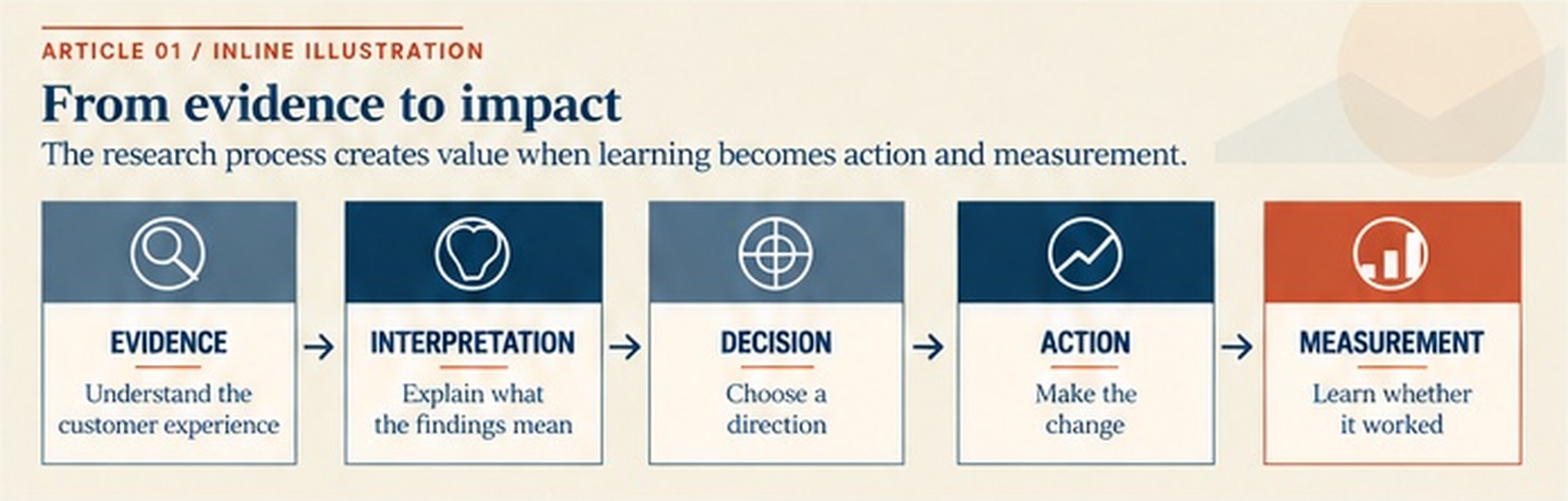
Read diagram text
The research process creates value when learning becomes action and measurement.
Evidence
Understand the customer experience.
Interpretation
Explain what the findings mean.
Decision
Choose a direction.
Action
Make the change.
Measurement
Learn whether it worked.
Research should inform decisions, not make them
There is an important boundary in this argument.
Researchers should not presume that research evidence is the only input into a business or product decision. Most meaningful decisions involve factors beyond the scope of UX research: engineering constraints, financial considerations, regulatory requirements, operational realities, market strategy, technical architecture, organizational priorities, and risk.
The role of research is not to override those considerations.
The role of research is to ensure that evidence about people—their behaviors, needs, expectations, difficulties, and experiences—is understood well enough to become a meaningful part of the decision.
That requires researchers to go further than simply saying, “Here are the findings.”
A more useful contribution is: “Based on the evidence, here is the problem we believe deserves attention. Here is why we believe that. Here is who appears to be affected. Here are the implications we think the organization should consider.”
The distinction is subtle but important.
The first approach transfers information.
The second contributes judgment.
As research organizations mature, I believe they need to become capable of both.
Activity is not the same as influence
This also changes the way we think about research impact.
A research organization can be extremely busy without necessarily being influential. The number of studies completed is primarily a measure of activity. The number of participants recruited is primarily a measure of volume. The number of teams using a research platform may tell us something about reach.
None of those numbers, by themselves, tells us whether the organization is making better decisions.
A more useful question is simply:
What happened next?
Did the research cause a product team to redefine the problem it was trying to solve?
Did an assumption that had been driving the roadmap turn out to be wrong?
Did evidence help leadership decide where to invest?
Did a team abandon an idea before spending months building it?
Did research resolve a disagreement that had been based largely on opinion?
Did the organization identify customer friction earlier than it otherwise would have?
Did we discover that the problem was not the interface at all, but a policy, process, service, or operational issue?
Those are meaningful forms of research impact because they connect evidence to organizational behavior.
Some of the most valuable research may result in something not being built. It may prevent an unnecessary investment, redirect a team toward a different problem, or expose an assumption before it becomes expensive.
Those outcomes are easy to miss if the research function is evaluated primarily by output volume.
Research impact continues after the decision
There is another important step that can also be overlooked.
After the organization makes a decision and takes action, did the change actually work?
Research teams frequently become involved during discovery or evaluation, complete their work, communicate the findings, and move on to the next project. That may be necessary in a busy environment, but it also breaks the learning loop.
Whenever possible, success measures should be considered early enough that the organization can return after implementation and determine whether the experience improved.
What changed in customer behavior?
Did people complete the task more successfully?
Did the friction we observed decrease?
Did the new experience solve the problem we identified?
Did we create a different problem?
What did we learn that should influence the next decision?
When that loop remains intact, research stops being a collection of individual studies and begins functioning as part of an organizational learning system.
That is a much more powerful role.
Senior researchers need to understand the decision, not only the method
This way of thinking also affects how I believe researchers should develop as they become more senior.
Methodological expertise remains fundamental. Researchers need to know how to frame questions, select methods, recruit appropriately, recognize bias, analyze evidence, and communicate findings responsibly. Those capabilities are the foundation of credible research.
But senior researchers and research leaders need another set of capabilities as well.
They need to understand the decision surrounding the research.
That means understanding the product strategy, the business context, stakeholder pressures, organizational constraints, and the tradeoffs leaders are trying to navigate. It means becoming curious not only about the user problem but also about why the organization is asking the question in the first place.
Sometimes that reveals that the requested research is not actually the research the team needs.
A stakeholder may ask for a usability study when the larger uncertainty is whether the concept solves a meaningful customer problem. A product team may ask which design customers prefer when the more important question is whether either approach addresses the behavior driving the problem. A leader may ask for another round of validation when the evidence necessary to make the decision already exists.
One of the most valuable things an experienced researcher can sometimes say is:
“We can answer that question, but I’m not sure it will help you make the decision you’re struggling with.”
That is not resistance. It is strategic research.
It is also one of the ways research moves from being perceived as a service function to becoming a genuine partner in decision-making.
Start with the decision
One of the simplest changes I recommend to research teams is to change one of the first questions they ask when work begins.
Instead of beginning with:
What do you want to learn?
Begin with:
What decision are you trying to make?
Then ask:
What evidence would give you greater confidence in that decision?
That seemingly small shift can fundamentally improve a research conversation.
It helps teams distinguish interesting questions from consequential questions. It exposes assumptions before they become embedded in a study plan. It makes method selection easier because the team understands what uncertainty it is actually trying to reduce. It also creates a clearer definition of success for the research itself.
When the work is complete, the team can return to the original decision.
What do we understand now that we did not understand before?
Did the evidence change our thinking?
What are we going to do differently?
What remains uncertain?
What should we measure next?
Those questions create continuity between learning and action.
Building research organizations around decisions
For research leaders, this has implications beyond individual projects.
If research exists to improve decisions, then the research operating model should be designed around the important decisions an organization needs to make.
That changes several things.
It changes how research is prioritized. A long queue of stakeholder requests may not be the best indicator of what deserves attention. Strategic importance, uncertainty, customer risk, and the potential cost of making the wrong decision become more useful considerations.
It changes how researchers communicate. The goal becomes less about presenting everything that was learned and more about helping the audience understand what matters.
It changes how impact is discussed. Instead of relying primarily on counts of studies or participants, research leaders can begin documenting decisions influenced, risks identified, priorities changed, assumptions challenged, and measures established.
And it changes the relationship between research and the rest of the organization. The research function becomes less focused on delivering studies and more focused on improving the organization’s ability to learn.
That is a much more durable form of value.
The goal is better decisions
Research creates knowledge. It builds empathy. It reveals behaviors that quantitative data alone may not explain. It challenges assumptions, reduces uncertainty, and gives customers and users a meaningful voice in the development of products and services.
All of those things matter.
But organizations ultimately invest in research because they have decisions to make.
They need to decide where to invest, which problems matter most, what to build, what to change, what to stop doing, and how to create better experiences for the people they serve.
The strongest research organizations I have encountered do more than generate evidence. They help people understand what that evidence means. They connect it to the decisions in front of the organization. They help teams act with greater confidence. And they continue learning from what happens afterward.
Because the value of research is not ultimately determined by how much we learn.
It is determined by what we do differently because we learned it.