
Research · Leadership
The Goal of Research Democratization Should Be Capability, Not More Researchers

Democratizing research isn't about turning everyone into a researcher. It's about building an organization capable of understanding its customers and making better decisions.
In this article
Research democratization has become an important ambition for UX organizations. As companies recognize the value of understanding their customers, they naturally want research to become more accessible. More teams want to conduct studies, more designers want direct access to customers, and more product leaders want evidence to inform their decisions.
The challenge is that the demand for research frequently grows faster than the research team itself. Democratization offers an appealing solution: give more people the tools, training, and opportunity to conduct research.
But I believe we sometimes confuse the mechanism with the objective.
The goal shouldn't be to produce as many people capable of conducting research studies as possible. It should be to build an organization that is better at identifying problems, questioning assumptions, understanding customers, and acting on evidence.
Those are two very different ambitions.
Over the course of my career, I've had the opportunity to build and lead research practices in organizations with very different needs, structures, and levels of research maturity. One lesson has consistently shaped my approach: research becomes more valuable when we build the capability of the organization, not simply increase the capacity to conduct studies.
And achieving that requires considerably more than giving people access to research tools.
Access is not the same as capability
There is a relatively straightforward way to democratize access to research. Give designers and product teams a research platform, provide introductory training, create templates, and encourage everyone to engage with customers.
Those are useful steps, but access alone doesn't create research capability.
A team may know how to launch a usability test without understanding whether usability testing is the appropriate method for its question. A designer may know how to write research tasks but unintentionally introduce bias. A product manager may receive compelling feedback from a small group of customers without understanding the limitations of that evidence.
These situations don't necessarily reflect a lack of effort or ability. Research is a discipline that requires judgment, and judgment develops through education, practice, experience, and mentorship.
Making research accessible without developing that judgment introduces a different kind of organizational risk. Instead of decisions being made without customer evidence, decisions may be made using evidence that is incomplete, inappropriate, or misunderstood.
The organization becomes more active in research without necessarily becoming more capable of learning from it.
This is why I believe research democratization has to be treated as an organizational development initiative rather than simply a platform adoption initiative.
The objective is not just to give more people the ability to conduct studies. It's to help them understand when research is appropriate, how to approach it responsibly, what conclusions the evidence supports, and when they need the expertise of an experienced researcher.
The goal of research democratization isn’t to make everyone a researcher. It’s to make the entire organization better at learning.
Building a practice that can grow beyond the team
I began developing this philosophy while working at Grainger, where I established a taxonomy research practice supporting an extensive e-commerce product catalog.
With more than 1.6 million products, the scale of the challenge was significant. Researching and evaluating the taxonomy exclusively through a small team of specialists would have limited how quickly the organization could learn and make improvements.
We needed an approach that would extend research capability into the teams making everyday decisions about the customer experience.
I built a four-person team, including myself, to establish the practice and support its expansion across online merchandising and product teams. Rather than attempting to conduct every evaluation ourselves, we started by establishing a research foundation that other people could eventually use.
We began at the highest levels of the taxonomy, using tree testing to evaluate how customers understood and navigated the product structure. We introduced benchmarks and scorecards that gave the organization a consistent way to evaluate performance and understand where improvements were needed.
As the practice developed, we enabled online merchandisers to conduct research within established guidelines, progressively transferring responsibility as their experience and confidence increased. Our research team increasingly focused on enablement while continuing to provide methodological expertise.
This wasn't simply about distributing work. We were developing a shared understanding of what good research looked like, how results should be interpreted, and how evidence could inform merchandising and product decisions.
Over time, those benchmarks and scorecards also became part of executive discussions. Research was extending beyond the people conducting studies and becoming part of how the organization evaluated its customer experience.
That experience reinforced an important distinction for me. The value of our small research team wasn't limited to the studies we could personally complete. It also came from the capability we were creating throughout the organization.
We could have focused exclusively on increasing our research output. Instead, we built a practice that allowed the organization to develop its own capacity for continuous learning.
ARTICLE 02 / INLINE ILLUSTRATION
The path to research capability
Tools open the door. Training and judgment make the organization more capable.
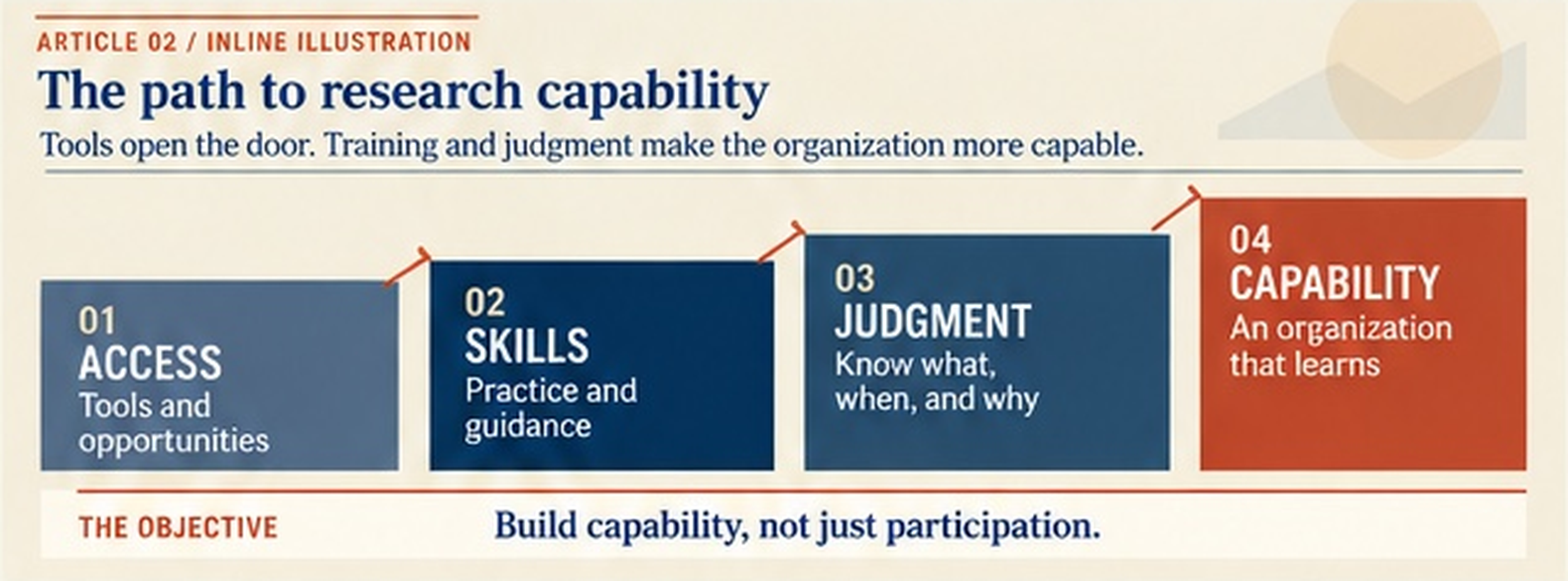
Read diagram text
Tools open the door. Training and judgment make the organization more capable.
- 01
Access
Tools and opportunities.
- 02
Skills
Practice and guidance.
- 03
Judgment
Know what, when, and why.
- 04
Capability
An organization that learns.
Democratization and expertise should strengthen each other
One of the concerns surrounding research democratization is that expanding participation will diminish the role of professional researchers. I understand that concern, particularly when democratization is presented primarily as a way to do more research without investing in additional expertise.
But I don't believe democratization and professional research need to compete. Properly designed, they should make each other more valuable.
Not every research question requires the same level of expertise. Some involve relatively straightforward evaluations where established methods, appropriate training, and clear guidance can enable designers and product teams to investigate questions responsibly. Others involve complex customer behaviors, sensitive populations, significant business risk, or strategic uncertainty that require the experience and methodological judgment of dedicated researchers.
Treating every research question as though it requires the same approach creates unnecessary constraints. Treating every research question as though anyone can answer it creates unnecessary risks.
The opportunity lies in building an operating model that recognizes those differences.
Experienced researchers should help establish methodological standards, develop organizational capability, mentor practitioners, and take responsibility for research requiring specialized expertise. Designers and product teams should develop the skills necessary to investigate appropriate questions, engage directly with customers, and use evidence throughout their everyday work.
Importantly, that doesn't mean professional researchers become less necessary. It means their expertise can be applied more deliberately.
When researchers aren't responsible for personally executing every routine evaluation, they have greater capacity to investigate strategic questions, explore emerging customer needs, identify problems that cross organizational boundaries, and help leaders make consequential decisions.
At the same time, designers and product teams become less dependent on a specialist for every customer interaction.
The result should be a stronger research organization and a more capable product organization.
Designing an operating model around organizational needs
My experience at USAA provided an opportunity to develop this philosophy on a considerably larger organizational scale.
When I began building the research organization, we started with three people: myself, a researcher, and a research operations coordinator. Within six months, we doubled the team, eventually growing to twelve people across research, research operations, and service design.
But increasing the size of the team was only part of the objective.
We were supporting a complex organization with multiple business lines and a large design ecosystem. A single centralized research team, regardless of how productive it became, couldn't address every research need or provide the level of organizational engagement we wanted to achieve.
We developed an operating model built around three complementary capabilities: centralized strategic research, business-aligned research, and democratized research enablement.
The centralized researchers focused on larger strategic initiatives that benefited from dedicated expertise. Business-aligned researchers developed relationships with the organizations they supported, helping connect research activity with product priorities and business needs. The enablement function focused on developing the ability of designers, product teams, and executives to understand and use human-centered insights.
Together, these capabilities supported an ecosystem of more than 250 designers across over twenty design teams.
The distinction between the three functions mattered. We weren't attempting to turn every designer into a professional researcher, nor were we expecting a centralized research team to personally conduct every study needed across the organization.
We were developing a system in which different types of research needs could be addressed through different combinations of expertise, proximity, and organizational capability.
Enablement was a particularly important part of that system. It extended beyond teaching designers how to use research tools. The broader objective was to help designers, product teams, and executive leaders understand the value of evidence and incorporate human-centered thinking into their work.
When I joined, human-centered insights were not part of the established Product Development Lifecycle. By the time I left, insights and design thinking had become critical activities throughout that lifecycle.
That evolution required more than additional researchers or greater research output. It involved changes in organizational expectations, leadership engagement, measurement, mentorship, and the ways teams approached product development.
It reinforced my belief that democratization is most valuable when it contributes to broader organizational transformation.
The research leader's responsibility is to build capability
There is an important leadership dimension to this approach.
When research leaders think primarily about the studies their teams are responsible for delivering, it's natural to organize around capacity. We estimate demand, allocate resources, manage the research backlog, and try to increase the number of studies we can complete.
Those responsibilities are necessary, but they represent only one part of building a successful research organization.
I believe research leaders should also be asking what capabilities the organization needs to develop and how the research function can help create them.
Where are teams making decisions without sufficient evidence? Which research activities could responsibly become part of a designer's everyday work? Where do product teams lack the skills to formulate meaningful research questions? Which strategic problems require experienced researchers? And what prevents executive leaders from incorporating human-centered evidence into their decisions?
The answers should influence how the research organization is designed.
In some environments, the greatest need may be a centralized team capable of tackling complex research initiatives. In others, the immediate challenge may be establishing consistent standards, developing research operations, or strengthening the relationship between researchers and product teams.
Frequently, the organization needs several of these capabilities working together.
What matters is that the operating model responds to organizational needs rather than treating research democratization as a universal solution.
Research leaders should be developing the people, practices, structures, and relationships that allow evidence to influence decisions throughout the organization. That requires thinking beyond the management of a research team and toward the development of an organizational capability.
Measure capability, not just participation
If capability is the objective, we also need to reconsider how we measure the success of democratization.
Research platform adoption, study volume, training participation, and the number of people conducting research can all provide useful information. They help us understand whether people have access to research and whether the organization is participating.
But they don't tell us enough about the quality or value of that participation.
I would rather understand whether teams are becoming more capable of asking meaningful questions, selecting appropriate methods, recognizing limitations, interpreting evidence, and making better decisions.
Are designers using research earlier in the product development process? Are product teams more confident in challenging their assumptions? Do practitioners understand when they can investigate a problem independently and when specialist expertise is necessary? Are research findings changing priorities, reducing uncertainty, or influencing investment decisions?
Those questions reveal something more meaningful about the organization's developing capabilities.
Research quality must remain part of that evaluation. Increased participation is not inherently beneficial if the resulting evidence is unreliable or interpreted incorrectly. A mature democratization program should improve both the accessibility of research and the organization's ability to recognize and apply good research practices.
We should also evaluate whether the model is improving how specialist researchers spend their time. If democratization simply creates additional responsibilities for a research team without changing the way work is distributed, supported, or prioritized, we may have increased complexity rather than organizational capability.
Ultimately, the measure of success should extend beyond how many people are conducting research to how effectively the organization is learning from it.
Building independence without sacrificing standards
There is a balance that research leaders have to maintain.
An organization that depends entirely on professional researchers for every customer interaction may struggle to develop continuous learning practices. But an organization that distributes research responsibilities without appropriate guidance risks making important decisions using unreliable evidence.
Neither extreme is particularly desirable.
The objective should be to build independence within a system that preserves methodological integrity.
That means developing practical guidance that helps people recognize which activities they can responsibly conduct. It means providing training and mentorship that go beyond the mechanics of a research platform. It means making expertise available when questions become more complex and establishing standards that help teams understand the strengths and limitations of their findings.
It also requires creating a culture in which asking for help is a sign of good judgment rather than an indication that someone has failed to become sufficiently independent.
A capable organization doesn't expect everyone to know everything. It understands where expertise resides, when to use it, and how different disciplines can contribute to better outcomes.
In that environment, democratization is not about replacing expertise with accessibility. It's about making expertise more accessible while developing the judgment necessary to use it effectively.
Build an organization that knows how to learn
The most important outcome of research democratization is not a larger population of people conducting studies. It is an organization that becomes progressively better at understanding the people it serves.
That capability should become visible in everyday work. Designers should understand how to investigate assumptions. Product teams should recognize where evidence is missing. Experienced researchers should have the opportunity to address increasingly complex and strategic problems. Executive leaders should expect human-centered evidence to inform important decisions.
Research should become less of an isolated activity and more of an organizational practice.
That is also why I believe democratization should never be treated as a substitute for investing in professional researchers. Building organizational capability requires expertise, leadership, mentorship, and ongoing attention to research quality. In many cases, it requires expanding the research organization while simultaneously developing the capabilities of everyone around it.
My experiences at Grainger and USAA involved different organizational challenges and operating models, but they reinforced the same principle: the reach of a research organization shouldn't be limited to the work its researchers can personally complete.
Its influence should extend through the people it develops, the practices it establishes, and the decisions it helps the organization make.
The goal of research democratization isn't to make everyone a researcher. It's to make the entire organization better at learning.