Research · Leadership
Research Maturity Isn’t About Doing More Research

A mature research organization isn't defined by how much research it produces. It's defined by how effectively the organization learns, makes decisions, and acts on what it discovers.
In this article
When organizations begin investing in UX research, success is often measured by the amount of research they conduct. They establish dedicated teams, implement research platforms, recruit participants, expand their methods, and increase the number of studies supporting product development.
These investments are important. They establish the infrastructure and expertise necessary to understand customers and improve their experiences. As research demand grows, increasing capacity can represent meaningful progress.
But I believe we sometimes confuse the growth of a research practice with the maturity of the organization it serves.
An organization can have an experienced research team, sophisticated tools, established processes, and an impressive volume of research activity while continuing to make important decisions without meaningful customer evidence. Research may be readily available but introduced too late to influence strategy. Findings may be widely distributed without changing priorities. Teams may understand how to conduct research without knowing how to incorporate what they learn into their everyday decisions.
The research function may be growing while the organization remains largely unchanged.
Over the course of my career, I've become increasingly interested in this distinction. Building research teams is important, but building organizations that consistently use research is a much more consequential leadership challenge.
For me, research maturity is ultimately about an organization's ability to make human-centered thinking a natural and dependable part of how it operates.
Research capability and organizational maturity are not the same thing
A research team can become more sophisticated without the broader organization developing alongside it.
Researchers may introduce new methodologies, improve recruitment, establish research operations, and develop increasingly sophisticated measurement programs. Meanwhile, product teams may continue involving research only when a design is nearly complete. Executives may rely primarily on financial and operational indicators when setting priorities, and customer evidence may remain largely disconnected from the decisions that determine what gets built.
In that environment, improvements within the research function are valuable, but they don't necessarily represent equivalent improvements in organizational maturity.
I find it useful to distinguish between the capability to produce research and the capability to use research. The first concerns the research function itself: its people, methods, infrastructure, standards, and capacity. The second concerns the broader organization: its culture, leadership, processes, decision-making practices, and willingness to respond to evidence.
These capabilities are closely related, but they develop differently.
An organization cannot become consistently evidence-driven without access to credible research. However, increasing the availability of research does not automatically create the leadership behaviors, organizational expectations, or operating practices necessary to make that evidence influential.
This distinction changes how research leaders should approach maturity. Rather than concentrating exclusively on strengthening their own teams, they also need to understand what prevents the rest of the organization from using the capabilities those teams provide.
Sometimes the constraint is insufficient research capacity. Other times, it is unclear ownership, competing priorities, limited methodological understanding, organizational silos, or a culture in which important decisions are made before research has an opportunity to contribute.
Understanding which constraints exist is essential. Otherwise, organizations risk investing in additional research capacity without addressing the conditions limiting its value.
The research function may be growing while the organization remains largely unchanged.
Maturity becomes visible in how an organization operates
One of the most revealing indicators of research maturity is not what happens during a research study. It's what happens before anyone requests one.
In a less mature environment, research is frequently reactive. A stakeholder identifies a question, requests a study, and expects the research team to return findings that support an upcoming decision. Sometimes the decision has effectively already been made, and research is being used primarily to confirm the proposed direction.
As an organization develops, its relationship with research begins to change. Product teams recognize uncertainty earlier. Designers engage with customers while exploring problems rather than waiting until they have solutions to evaluate. Researchers become involved in discussions about priorities and opportunities, not simply the execution of research requests.
More importantly, leaders begin expecting evidence to inform decisions rather than treating research as an optional activity.
That expectation creates a different organizational environment. Teams become more comfortable acknowledging what they don't know. Assumptions are discussed more openly. Research questions become connected to strategic priorities, and findings have a clearer path into product planning and decision-making.
None of these changes necessarily requires conducting more studies.
They require changes in organizational behavior.
A team that conducts fewer, more strategically relevant studies and consistently applies what it learns may demonstrate greater maturity than a team conducting substantially more research whose findings rarely influence decisions.
Research maturity should therefore be evaluated through the organization's practices and decisions, not simply the productivity of its researchers.
Changing how an organization approaches product development
My experience at USAA helped shape this perspective.
When I began building the research organization, human-centered insights were not an established part of the Product Development Lifecycle. Developing that capability required more than increasing the availability of research or expanding the team.
We needed to change how the organization understood the role of human-centered insights throughout product development.
Our research organization initially consisted of three people. Within six months, we doubled the team and eventually grew to twelve, combining researchers, research operations professionals, and service designers. We developed an operating model that supported centralized strategic research, business-aligned research, and research enablement across a large design ecosystem.
The team ultimately supported more than 250 designers across over twenty design teams. But the scale of the organization was only part of what mattered.
The broader objective was to strengthen the organization's ability to understand and use insights. Our enablement efforts extended beyond designers to product teams and executives because research maturity couldn't be achieved by developing research practitioners alone.
Leadership engagement was particularly important. We worked to strengthen understanding of human-centered methods and demonstrate how evidence could contribute to product development and organizational priorities. I developed measurement and maturity models that helped demonstrate the organizational impact of insights and their relationship to key performance indicators.
These activities supported a broader change in how research and design thinking were understood and applied. By the time I left USAA, human-centered insights and design thinking had become critical throughout the Product Development Lifecycle.
For me, that organizational shift represents a more meaningful indicator of maturity than the increase in research capacity alone.
Building the team gave us the expertise and resources to support the organization. Developing the operating model, enabling people throughout the business, engaging leadership, and demonstrating impact helped establish a broader organizational capability.
The important change wasn't simply that we were conducting more research. It was that human-centered evidence had become an increasingly important part of how the organization approached product development.
ARTICLE 03 / INLINE ILLUSTRATION
Capability is necessary. Maturity is broader.
A stronger research practice matters when evidence also changes how the organization operates.
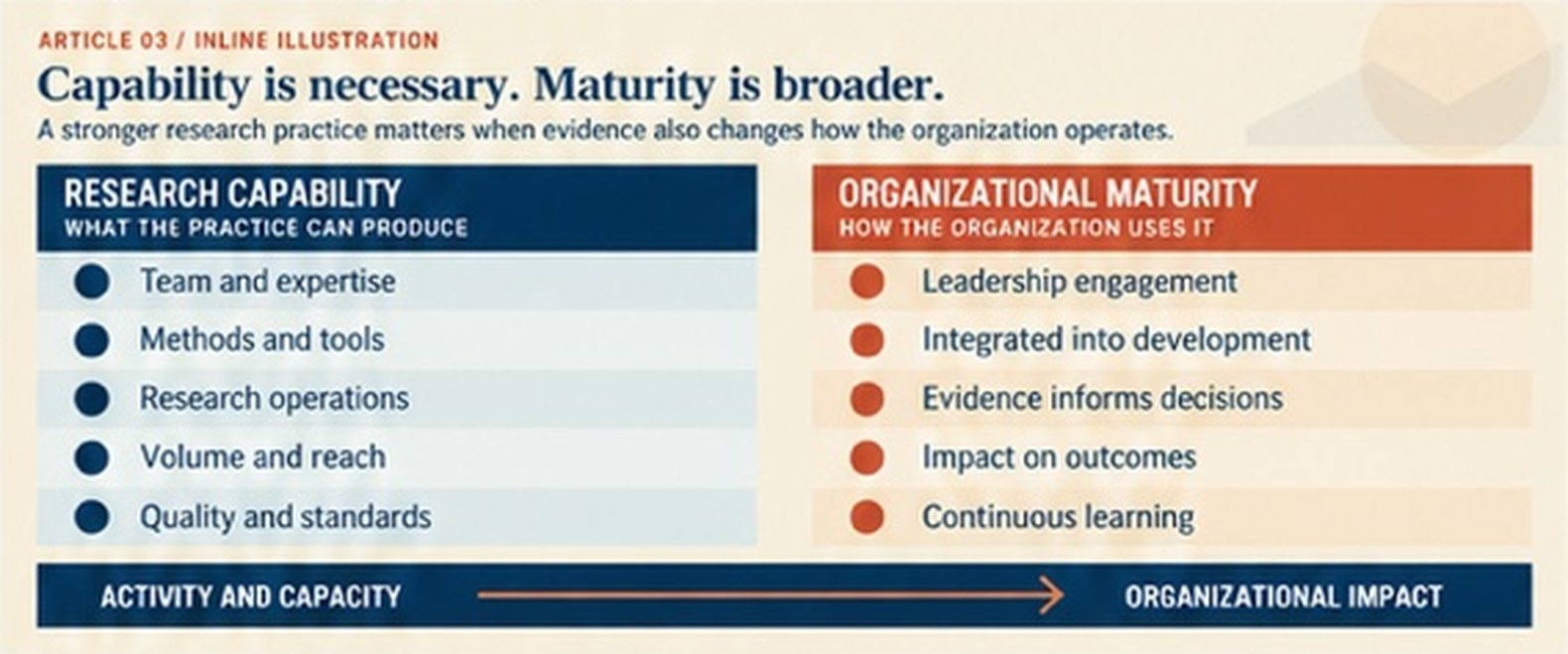
Read diagram text
A stronger research practice matters when evidence also changes how the organization operates.
Research capability
What the practice can produce.
- Team and expertise
- Methods and tools
- Research operations
- Volume and reach
- Quality and standards
Organizational maturity
How the organization uses it.
- Leadership engagement
- Integrated into development
- Evidence informs decisions
- Impact on outcomes
- Continuous learning
The importance of executive leadership
Research maturity is sometimes treated as a challenge that research leaders must solve primarily through improvements to their own teams. They are expected to introduce better tools, expand methodologies, improve research operations, develop researchers, and establish more efficient processes.
Those responsibilities matter, but there is a limit to what a research leader can accomplish without corresponding changes in executive expectations and organizational behavior.
If leadership expects research to validate decisions rather than inform them, even an exceptionally capable research organization will struggle to operate strategically.
This is why I believe executive engagement is a fundamental component of research maturity.
Executives influence which questions are considered important, where organizations invest, how performance is evaluated, and which activities become part of established operating practices. Their expectations help determine whether teams treat human-centered evidence as essential or optional.
But executive support needs to extend beyond expressing enthusiasm for customer-centricity.
Leaders need to understand how research contributes to the decisions they are responsible for making. They need sufficient familiarity with research to recognize when evidence is appropriate, understand its limitations, challenge assumptions, and interpret findings alongside financial, operational, and strategic considerations.
They also need to create the organizational conditions that allow teams to act on what they learn.
This doesn't mean executives need to become researchers. It means developing the judgment necessary to use research effectively as part of their leadership responsibilities.
Mentorship and education can play an important role in that development. Research leaders have an opportunity to help executives understand not only what research has discovered but also how different approaches to learning can improve the organization's ability to make decisions.
When that understanding becomes part of executive leadership, research is better positioned to influence the organization beyond individual projects.
Measurement should demonstrate progress, not simply describe activity
Research maturity models and measurement frameworks can help organizations understand where they are, identify gaps, and establish priorities for improvement. However, their usefulness depends on what they measure and how the organization applies the results.
If maturity is evaluated primarily through research volume, tool adoption, or methodological sophistication, the organization may conclude that its practice is advancing without understanding whether those investments have changed how decisions are made.
Activity measures are useful indicators of capacity, reach, and participation, but they provide an incomplete picture of organizational maturity.
I believe maturity assessments should also examine how research is integrated into strategic planning, how consistently teams engage with evidence, whether leaders understand and use insights, and whether findings influence priorities and decisions.
Measurement should help the organization identify what needs to change rather than simply demonstrate that research activity is increasing.
There is also an important relationship between research maturity and experience measurement.
If an organization has established meaningful experience measures, it can begin connecting research activity with changes in customer behavior, experience quality, and relevant business outcomes. Those connections help leadership understand why investments in research capability matter.
During my time at USAA, developing measurement and maturity models was an important part of demonstrating the organizational impact of human-centered insights and their relationship to key performance indicators.
The underlying principle is one I continue to emphasize: measurement should help organizations understand both their current capabilities and the results those capabilities make possible.
A maturity assessment is most valuable when it informs decisions about organizational development. It should help leaders determine where additional expertise is needed, which capabilities should be strengthened, what barriers need to be addressed, and how the organization will recognize meaningful progress.
Otherwise, the assessment risks becoming another report that documents the current state without contributing to meaningful change.
Technology can accelerate maturity, but it cannot create it
Technology has dramatically expanded what research organizations can accomplish. Research platforms have made it easier to recruit participants, conduct studies, analyze evidence, share findings, and extend research participation beyond dedicated research teams.
AI-enabled capabilities are creating additional opportunities to accelerate parts of that process.
These developments can increase efficiency and make research more accessible. But technology introduces an important distinction between the ability to generate evidence and the organizational ability to use it.
Providing more people with sophisticated research tools does not automatically improve their methodological judgment. Accelerating analysis does not guarantee that findings will be interpreted correctly. Making research repositories searchable does not ensure that product teams will incorporate previous learning into new decisions.
An organization can become considerably more efficient at producing and distributing research without developing greater research maturity.
Technology should therefore be evaluated in the context of the organizational capability it supports.
Does it make credible evidence easier to obtain? Does it help teams engage with customers earlier? Does it reduce unnecessary operational work so experienced researchers can focus on more consequential questions? Does it improve the organization's ability to discover, understand, and reuse existing evidence?
And perhaps most importantly, does it strengthen the connection between what the organization learns and what it subsequently decides to do?
Those questions are particularly important as organizations consider adopting AI-enabled research capabilities. Faster research can be valuable, but accelerating an ineffective process doesn't necessarily produce better outcomes.
The objective should be to use technology to support a more capable organization rather than treating technology adoption itself as evidence of maturity.
Maturity is not uniform across an organization
Another important consideration is that organizational research maturity rarely develops evenly.
Different business units, product teams, and leadership groups may have very different relationships with research. One team may consistently integrate customer evidence throughout discovery, development, and measurement, while another relies primarily on usability testing shortly before release.
Some executives may actively seek out research when setting priorities, while others may have limited experience interpreting qualitative evidence. Established teams may have developed effective research practices that newer teams have not yet adopted.
These differences matter because they make organization-wide maturity difficult to describe with a single measure.
An organization may have a highly capable central research team while important parts of the business lack the ability or opportunity to use its expertise. It may have excellent research practices within individual product teams but little coordination or shared learning across the enterprise.
Research leaders need to understand those differences rather than assume that the maturity of the research function accurately represents the maturity of every team it supports.
They also need to recognize that different parts of an organization may require different approaches to improvement.
One team may need foundational training and methodological guidance. Another may benefit from deeper integration with experienced researchers. A third may already possess strong research capabilities but struggle to communicate findings or influence leadership decisions.
A useful maturity model should make those differences visible and help establish appropriate priorities.
The goal isn't necessarily to make every team operate identically. It's to ensure that teams have access to the capabilities, expertise, and organizational support appropriate to the decisions they need to make.
Building an organization that continuously learns
One of the strongest indicators of organizational maturity is what happens after an individual research initiative ends.
In organizations where research remains largely project-based, findings may inform an immediate design decision before the team moves on to its next assignment. Even when individual studies are successful, the organization may struggle to retain knowledge, apply previous learning, or understand whether its decisions produced the intended results.
A more mature organization develops ways to make learning continuous.
Research findings remain accessible and useful beyond the original project. Teams recognize opportunities to build on previous evidence rather than repeatedly investigating the same questions. Experience measures help the organization understand whether implemented changes are improving outcomes. New findings challenge earlier assumptions and inform future priorities.
This requires more than a research repository or a recurring research schedule.
Continuous learning depends on establishing relationships between research, product development, organizational knowledge, and experience measurement. It also requires teams to remain open to evidence that challenges previous decisions.
That last point is particularly important.
Research maturity should make organizations more comfortable with uncertainty, not simply more confident in their existing beliefs. A mature organization recognizes that its understanding of customers is always incomplete and that evidence may require it to reconsider decisions it has already made.
The willingness to change direction when new evidence emerges is an important expression of maturity.
So is the ability to recognize when additional research is unnecessary because the organization already has sufficient evidence to make a responsible decision.
Continuous learning isn't about conducting research continuously for its own sake. It's about maintaining the organizational capacity to learn whenever learning is necessary.
Research leaders must think beyond the research organization
As research organizations mature, I believe the responsibilities of their leaders also evolve.
Building a strong research team remains essential. Researchers need opportunities to develop their expertise, appropriate operational support, clear expectations, and meaningful career development. The organization needs credible methods, ethical standards, and reliable ways to produce and communicate evidence.
But research leaders also have a responsibility to improve the environment in which that work is used.
That means building relationships across Product, Design, Technology, Operations, and executive leadership. It means understanding how important decisions are made, where evidence enters the process, and what prevents teams from acting on what they learn.
Sometimes the most consequential contribution a research leader can make isn't introducing a new methodology or increasing research capacity. It's helping the organization change when research becomes involved, how evidence is interpreted, or which questions leaders expect teams to investigate before committing resources.
This requires research leaders to operate as organizational leaders.
They must understand strategy, organizational development, measurement, and the practical challenges of changing established behaviors. They need to develop other leaders, build organizational confidence in research, and create operating models that make human-centered thinking sustainable.
Ultimately, they need to design for an organization that becomes increasingly capable of learning and making decisions without depending on the research leader's personal involvement in every initiative.
That's a different ambition from simply building a larger or more productive research team.
Maturity is demonstrated through behavior
Research maturity isn't a destination that organizations reach by implementing a particular platform, achieving a prescribed study volume, or adopting an established set of methodologies.
It is a capability that develops as organizations change how they approach problems, engage with evidence, make decisions, and evaluate results.
An organization may need to conduct substantially more research as part of that development. It may need additional researchers, stronger research operations, new technology, better measurement practices, or more extensive training. Those investments can be essential.
But they should serve a larger purpose.
The measure of progress is whether those investments have changed the organization's ability to understand the people it serves and incorporate that understanding into meaningful decisions.
Are teams identifying important questions earlier? Are leaders expecting evidence before committing to a direction? Are researchers influencing strategy rather than primarily validating solutions? Is customer understanding becoming part of everyday product development? Does the organization learn from the results of its decisions?
Those are the changes that interest me most.
Because a research organization can become larger, faster, and more sophisticated without fundamentally changing the organization around it.
Research maturity isn't about doing more research. It's about building an organization that knows how to learn from research—and has the ability and willingness to act on what it discovers.